All posts by mayor

Slovak Technical Museum

  • Slovak Name: Slovenské Technické Múzeum
  • Location: Hlávna Street

The Slovak Technical Museum in Košice is one of the largest technical museums in Central Europe. It was established in 1961 and focuses on the history of technology, industry, and transport. It houses a collection of over 100,000 objects.

Exhibits are displayed across several buildings and outdoor spaces, allowing visitors to see full size models, machines, vehicles and technological demonstrations. Some of the main sections include mining, metallurgy, textiles, paper production, printing, graphic arts, electrical engineering, transport and communication technologies through the ages. Visitors can see historic steam engines and locomotives, mining equipment, weaving looms, printing presses, early computers and phones, and vintage cars, trucks and tractors.

With its rich collection and displays, the Slovak Technical Museum portrays how technology helped drive industrialization and shaped societies over the past two centuries.

Museum of Aviation

  • Slovak Name: Múzeum letectva Košice
  • Location: Košice Airport

The Museum of Aviation is located at the International Airport in Košice. It opened in 2002 to showcase Slovakia’s aviation history and development.

The museum’s indoor exhibition hall displays full-scale aircraft as well as models, photos, documents and interactive devices tracing the evolution of airplanes and air transport. Some of the historic planes exhibited include Slovak-built aircraft from pre-World War II as well as Soviet-era military jets like the MiG-21 and L-29 Delfin. Outside the main building, visitors can see static displays of larger planes.

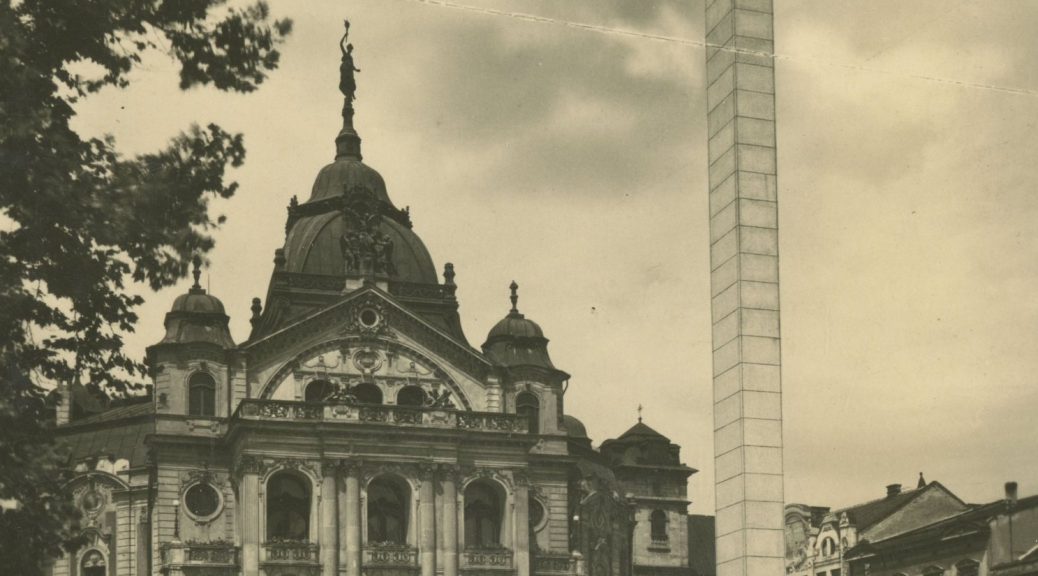
The Czechoslovak Pillar

  • Slovak name: Československý pamätný stĺp
  • Location: In front of the National Theatre
  • Architect: Miloslav Kopřiva
  • Foundation: 1933
  • Demolition: 1939
Demolition of the pillar in 1939

Image source: https://foto-ulic.appspot.com

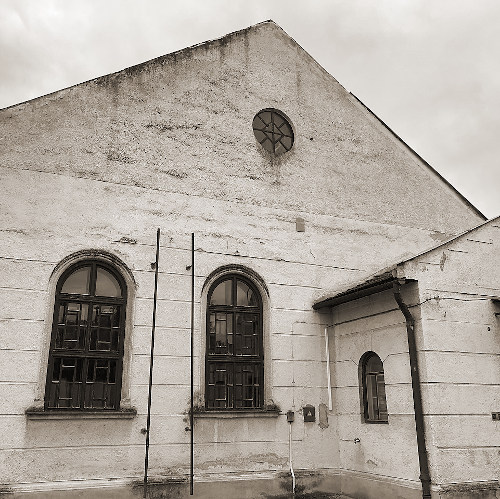
The Hasidic Synagogue

  • Slovak name: Chasidská synagoga
  • Location: Krmanova Street
  • Foundation: 1920
  • Confession: Hasidic Judaism

When World War I reached the Northern border of Slovakia in 1915, the Hasidic Jewish community of Stropkov (SK) and Radomyśl Wielki (PL) fled from the Russian army to Košice – back then one of the largest Jewish centres of this part of Europe – where they joined the orthodox community. After the war in 1920, the Hasidic community built an own synagogue on today’s Krmanova Street.

The elongated building is covered by a gable roof. Its design is simple, and it has high round-arched windows. In its original form, the synagogue had two prayer halls facing to the East, each of which could be entered from the South and the North through a vestibule.

The Hasidic Synagogue’s interior underwent a massive remodelling between 1957 and 1959, and serves today as a technical laboratory for metals.

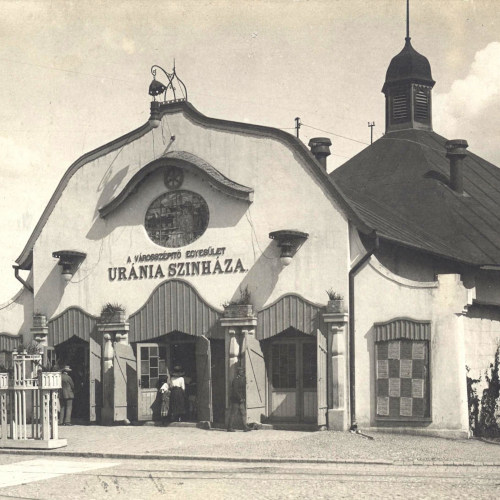
Kino Uránia

  • Location: Námestie osloboditelov
  • Foundation: 1909
  • Demolition: 1939

On the 30th May 1909 the Kino Uránia, one of Košice’s first cinemas, opened its doors for the first time. Soon after it had been renamed to Bio Radio. It was located on today’s Liberation Square where the shopping centre Aupark can be found.

The cinema – which was mainly built due to the initiative of city counsellor and film enthusiast Lajos Ékes Körmenda – had a capacity of more than 700 seats, the tickets were divided into three price categories. Instead of lengthy drama productions, Kino Uránia preferred to show documentaries, news and scenes from everyday life.

In the last years of its activity, Kino Uránia had become less popular, and it was pejoratively called “rats’ cinema”, as the small rodents had slowly overtaken the building. In 1939 the cinema stopped operating and was subsequently torn down.

Image source: https://foto-ulic.appspot.com

The Honvéd Monument

  • Location: Next to St. Michael’s Chapel
  • Foundation: 1906
  • Demolition: 1919

Where today there is a fountain next to St. Michael’s Chapel, once a proud monument was located: the Honvéd-szobor. A bronze statue with two larger-than-life depictions of men, standing on a pedestal on a small hill.

The monument was erected and unveiled on September 9th 1906 in memory of the 9th Patriotic Battalion of Košice, which fought in the Hungarian Civic Revolution and War of Independence in 1848-49. Although the revolution failed, it is one of the most significant events in Hungary’s modern history, forming the cornerstone of modern Hungarian national identity. ‘Honvéd’ means ‘homeland’ in Hungarian.

The bronze statue depicted a soldier of the 48th national guard, behind him a knight of the Kuruc Army, a group of armed anti-Habsburg insurgents in the Kingdom of Hungary between 1671 and 1711.

After Slovakia had joined the first Czechoslovakia, the Honvéd monument was torn down on the 17th of March 1919.

Image source: https://foto-ulic.appspot.com

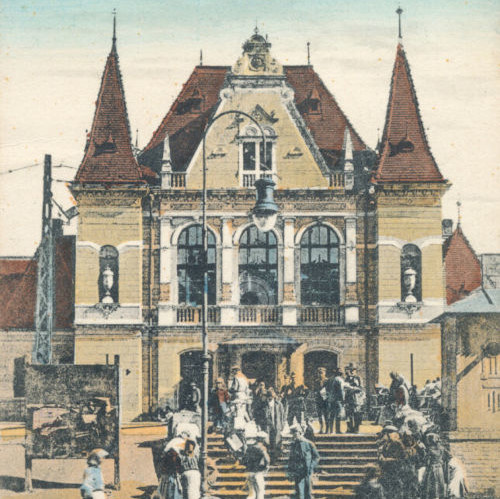
The Old Railway Station

  • Foundation: 1896
  • Demolition: 1970s
  • Location: Staničné námestie
  • Style: Neogothic

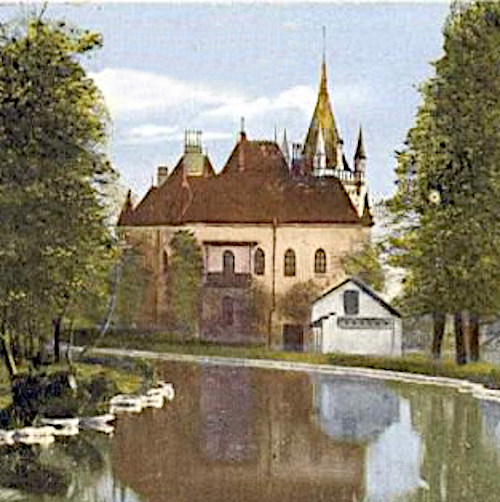
In the 1890s, first trains were going to and from Košice. Train travelling quickly became popular, a proper station was necessary. Renowned Hungarian architect Jozef Hubert was given the assignment to create a new station building.

A magnificent Neo-Gothic construction saw the light of day in 1986, encompassing elements of French Renaissance castles.

In the following decades, the romantic building should become one of the city population’s most-beloved sights. In the 1970s, the station was torn down in order to make place for a new one.

Image source: https://foto-ulic.appspot.com

The Central Mill and the Fire

  • Slovak Name: Stredný Mlýn, Starý Mlýn
  • Foundation: 1863
  • Demolition: 23. August 1976
  • Location: Southern extension of the City Park

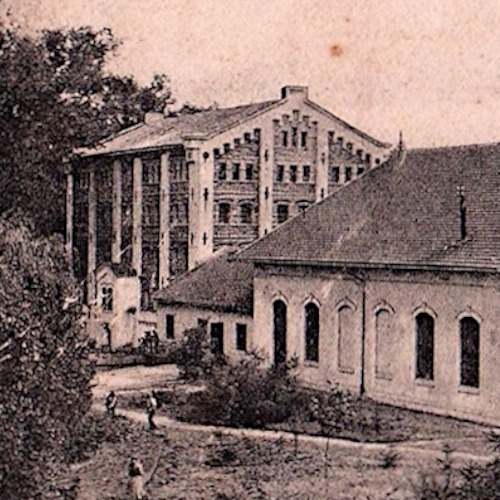
During the time when the river was still flowing through the centre of Košice, several mills were located by its water. One of them was the Central Mill, located in what is nowadays the southern extension of the city park.

In the year 1862 the newly-founded company Košice Artificial Mill purchased the Central Mill from the city and built two multi-storey buildings in its proximity. The mill expanded over time. During a reconstruction in the year 1900 the nearby bathhouse was torn down.

In 1945, the Central Mill was nationalised and in 1948 the East Slovak Mills Company began to operate it.

On 23rd of August 1976 the mill was hit by a devastating fire which, according to eyewitnesses, was glowing for several weeks. The conflagration left only ruins behind.

Today, a small hill is the sole remainder of the Central Mill.

Image source: https://foto-ulic.appspot.com