All posts by mayor

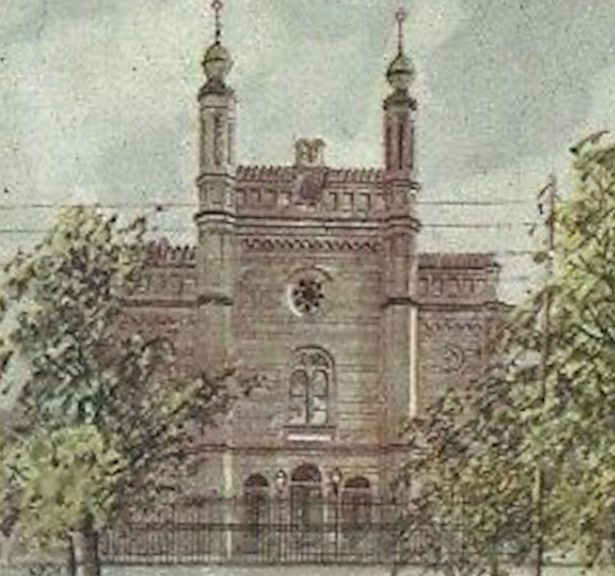
The Controversial Synagogue

  • Foundation: 1866
  • Demolition: 1958
  • Location: Moyzesova Street
  • Style: Moorish style
  • Architect: Michal Répaszky

Kosice’s oldest synagogue was once an old granary on Zvonárska street which had been converted to a synagogue in 1844. As the Jewish community grew quickly in the next decades, it was decided to construct a bigger house of prayer. In 1866 a new synagogue was built on Moyzesova street after plans by architect Michal Répaszky.

The two towers which reminded many of the ones on Christian churches, as well as the placement of the Almenor, the raised rostrum from which the Torah is read, at the upper end of the house of prayer instead of in its centre led to controversy within the Jewish community. Some considered it a sin to even enter the new church building. This controversy led eventually to a schism of Košice’s Jewry into three factions: Orthodox, Neologist, and Status Quo Ante, i.e. those who hadn’t joined any of the other two.

The dispute went thus far, that the critics of the new synagogue turned to the Minister of Religion and Education, who sent mediators to Košice in order to discuss the contradictions within the Jewish community. The new synagogue was given to the Neologist community, while a small conservative-style synagogue was constructed right next to the large one by the Status Quo Ante. The Orthodox believers continued to visit the synagogue on Zvonárska street. In 1899 the Orthodox community built a proper synagogue on the same street.

In 1926 the Status Quo Ante and Neologist communities switched their synagogues. The Neologists tore down the small building and replaced it with a modern temple with a cupola (nowadays the House of Arts). The Status Quo Ante believers transformed the large synagogue to their needs by tearing down the two towers and putting the Almenor in the centre. It was inaugurated in 1927. The Orthodox community built a larger synagogue in the same year on Puškin street.

The Shoah had taken its toll on the Jewish populace in Košice which had become significantly smaller after 1945. Eventually, the large synagogue had fallen into disrepair and was torn down in 1958 to make place for the extension of the later House of Arts.

Image source: https://foto-ulic.appspot.com
The Old Theatre

  • Location: Main Street
  • Foundation: 1787-1790
  • Demolition: 1897
  • Architect: Štefan Brocký, Jozef Ján Taller
  • Style: Classicism

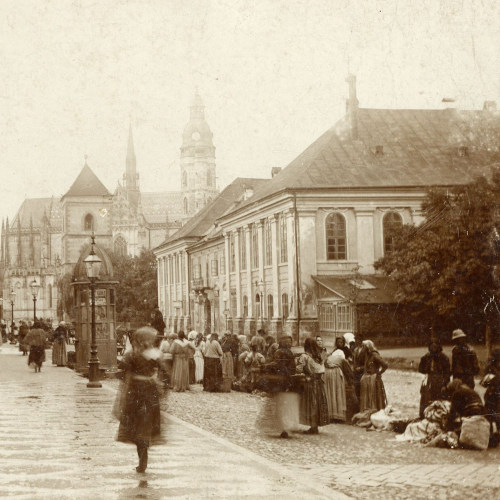
On the place where the famous Košice National Theatre is standing today was once a smaller but also very beautiful theatre. The constructions began in 1787, one year later it opened its gates to the public, but the building was not finished until 1790. The project was supervised by Štefan Brocký and Jozef Ján Tallher, the construction was led by Anton Schwaizer. With it, Košice got its first permanent theatre made of stone.

The Classicist building consisted of a coffee-house with billiard tables and a dining room, as well as a redoute and a smoking room in the Northern part and a theatre hall in the Southern part, both of which were connected by a hallway. In addition to the parterre, the theatre hall had three galleries with lodges and altogether a capacity of 500 visitors.

The first mentioned performance was Mozart’s The Abduction from the Seraglio in 1789, the year of the French Revolution (Mozart was still alive at that time). At first, plays were only performed in German, from 1816 alternately in German and Hungarian. In 1828 a men’s casino was opened in the building where the high society of Košice met to play board games.

In 1884 a fire broke out during a performance. For security reasons, the theatre was closed in 1894 and eventually demolished in 1897. In January 1897, the city council approved a new theatre project by Adolf Láng which was opened on the 18th of September 1899.

Image source: https://foto-ulic.appspot.com

The Short Life of the Citadel

  • Foundation: 1671
  • Demolition: 1713
  • Location: Námestie osobotitelov (Shopping Centre Aupark)
  • Style: Baroque

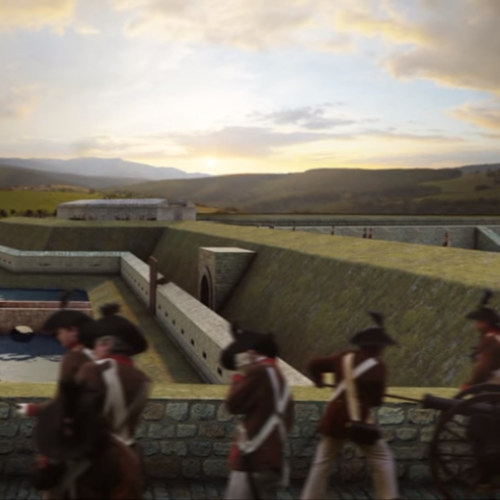
The Southern end of Hlavá Street, where now the shopping centre Aupark can be found, was once the location of an enormous Baroque citadel. Its construction began in 1671 in the context of the anti-Habsburg Uprisings in the Kingdom of Hungary, which lasted from 1607 to 1711.

The citadel to the South of the city

The fort was erected right outside the Southern city walls, was star-shaped with five bastions. It occupied an area of approx. 25 hectares.

In the aftermath of the failed Tököli Uprising, the wall facing the city was demolished in 1685, rendering the fortification ineffective.

The wall facing the city was demolished

In 1713, the citadel was demolished by order of Emperor Charles III. After that, the remains of the fort were gradually removed to provide material for the construction of new buildings on Main Street.

In 2008 archaeological research officially began. When the construction of the shopping centre Aupark began in 2010, several parts of the bastion were unearthed. Some parts of the walls are exhibited nowadays in the vicinity of the shopping centre.

An informative video about the citadel by Aupark

Image source: https://www.auparkkosice.sk/obsah/kosicka-citadela